What is the Ayushman Bharat Digital Mission?
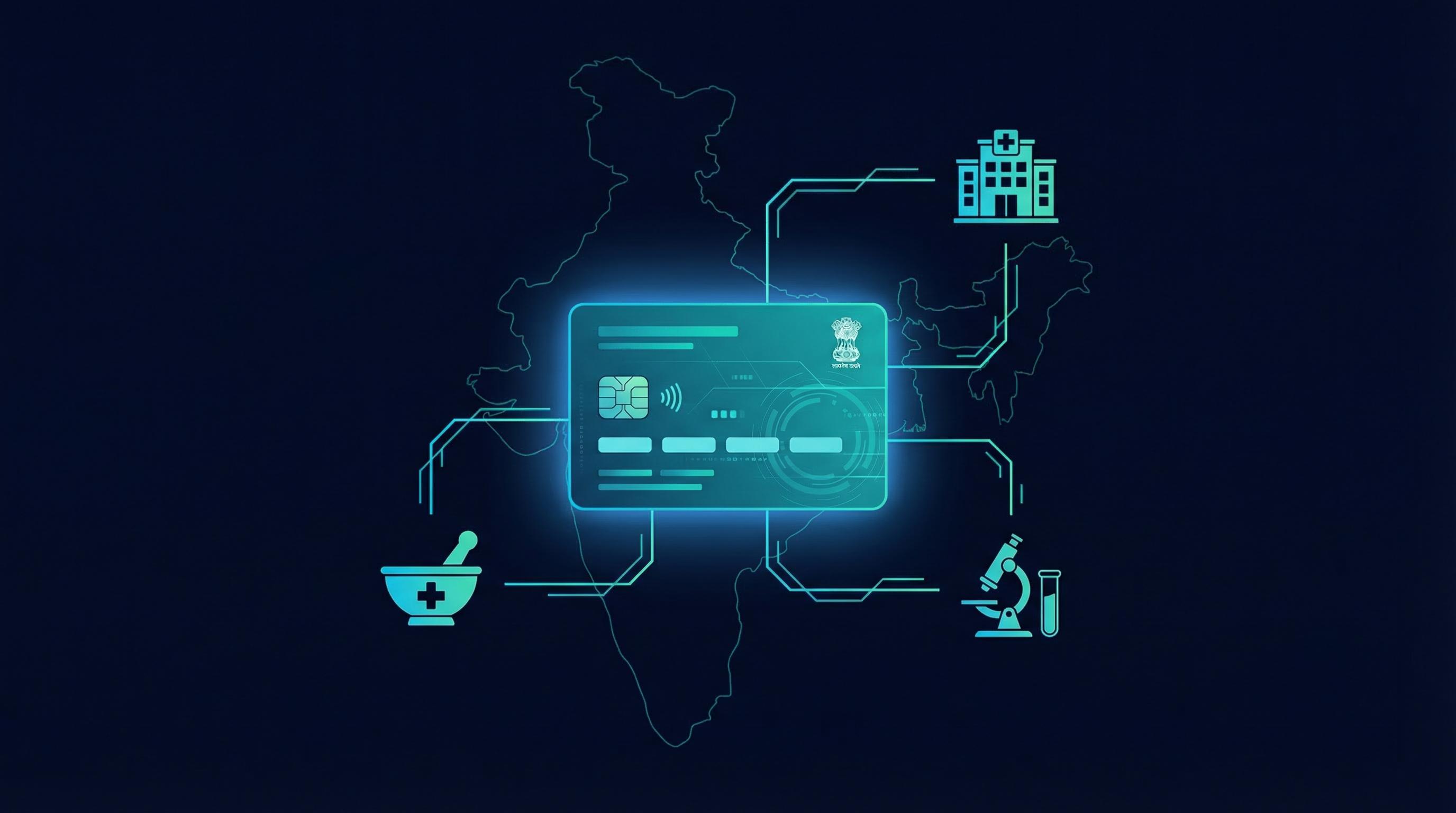
The Ayushman Bharat Digital Mission (ABDM), launched by the Government of India in September 2021, is the country's most ambitious effort to create a unified digital health ecosystem. Think of it as the UPI of healthcare — a foundational layer that connects patients, doctors, hospitals, pharmacies, labs, and insurance providers through a common digital infrastructure.
Just as UPI transformed financial transactions by creating interoperability between banks and payment apps, ABDM aims to make health records portable, shareable, and accessible across the entire healthcare system.
The mission operates under the National Health Authority (NHA) and is built on four key pillars:
1. ABHA (Ayushman Bharat Health Account)
Every citizen can create a unique 14-digit ABHA number (formerly called Health ID). This serves as a universal health identifier — similar to how Aadhaar works for identity verification, ABHA works for health records.
As of early 2026, over 600 million ABHA accounts have been created. The government's target is to cover all 1.4 billion citizens.
2. Healthcare Professionals Registry (HPR)
A comprehensive database of all verified healthcare professionals in India — doctors, nurses, dentists, pharmacists, and allied health workers. Registration on HPR gives practitioners a unique digital identity that validates their credentials across the system.
3. Health Facility Registry (HFR)
Every clinic, hospital, pharmacy, and diagnostic lab in India can register on HFR to receive a unique facility identifier. This registration is the first step for any healthcare facility that wants to participate in the ABDM ecosystem.
4. Health Information Exchange & Consent Manager (HIE-CM)
This is the backbone of data sharing. When a patient visits a new doctor, the doctor can request access to the patient's historical health records. The patient receives a consent request, approves it, and the records flow securely from the previous provider to the new one — all digitally.
What is ABHA and Why Does It Matter?
ABHA (Ayushman Bharat Health Account) is the patient-facing component of ABDM. Here's what doctors need to understand:
For Patients
- A 14-digit unique health ID linked to their Aadhaar or mobile number
- A single place to store and access all their health records — prescriptions, lab reports, discharge summaries, vaccination records
- Full control over who can access their records through a consent-based system
- Portability: records follow the patient, not the hospital
For Doctors and Clinics
- Instant access to a patient's complete medical history (with consent)
- No more relying on patients to remember their medication history or bring old reports
- Reduced duplicate testing — if a recent lab report exists, you can see it
- Digital prescriptions linked to the patient's ABHA automatically become part of their permanent health record
For the Health System
- Better epidemiological data for public health planning
- Reduced fraud in insurance claims
- Improved coordination between primary, secondary, and tertiary care
- A foundation for telemedicine and remote healthcare delivery
Current Status: Where Are We in 2026?
ABDM has made significant progress, but adoption is uneven:
What's working well:
- ABHA creation is seamless — patients can create an account in under 2 minutes via the ABHA app or website
- Major hospital chains (Apollo, Fortis, Max, AIIMS) have integrated their systems with ABDM
- Government health schemes are increasingly requiring ABHA for claim processing
- The Unified Health Interface (UHI) is enabling cross-platform health service discovery
What's still evolving:
- Small and mid-size clinic adoption remains low — most private practitioners haven't registered on HFR yet
- Interoperability between different EHR systems is improving but not yet seamless
- Patient awareness about ABHA benefits is still limited outside major cities
- Data standards (FHIR-based) are being refined for Indian healthcare contexts
What Should Clinics Do Right Now?
Whether ABDM integration is mandatory for your practice today or not, preparing now is a strategic advantage. Here's a practical roadmap:
Step 1: Register on Health Facility Registry (HFR)
Visit the HFR portal (facility.abdm.gov.in) and register your clinic. You'll need:
- Clinic name and address
- Owner/doctor details with medical registration number
- Aadhaar verification for the owner
- Basic facility information (type, specialties, services)
Registration is free and takes about 15 minutes.
Step 2: Register on Healthcare Professionals Registry (HPR)
Every doctor at your clinic should create an HPR profile at hpr.abdm.gov.in. This requires:
- Medical Council registration number
- Aadhaar verification
- Professional qualification details
Step 3: Start Creating ABHA IDs for Patients
When patients visit your clinic, help them create an ABHA if they don't have one. You can do this through ABDM-integrated software or via the ABHA app. This builds a habit and positions your clinic as digitally forward.
Step 4: Use ABDM-Compatible Software
This is where most clinics face a decision. Your clinic management system needs to be ABDM-compatible to:
- Link patient records to their ABHA
- Push health records (prescriptions, notes) to the ABDM network
- Pull existing records from other providers (with patient consent)
- Generate FHIR-compliant health documents
Not all clinic software supports this yet. When evaluating options, look for systems that are ABDM-certified or have a clear integration roadmap.
Step 5: Train Your Staff
Your front-desk staff should know how to:
- Ask patients for their ABHA number
- Help patients create an ABHA if needed
- Explain the benefits of ABHA to hesitant patients
- Handle consent requests for record sharing
How Healthcare With AI is Preparing for ABDM
At Healthcare With AI, we are building ABDM integration directly into our clinic management platform. Our goal is to make ABDM compliance effortless for clinics — not another administrative burden.
Here's what we're working on:
- ABHA Verification at Check-in: When a patient arrives, the system can verify their ABHA and pull relevant medical history with one click
- Automatic Record Pushing: Prescriptions, consultation notes, and lab orders generated through our platform will automatically be pushed to the patient's ABHA-linked health record
- Consent Management: A simple interface for handling patient consent requests — incoming and outgoing
- FHIR Compliance: All health documents generated by our platform will conform to ABDM's FHIR-based data standards
This integration is currently in development and will be rolling out in phases throughout 2026.
Why This Matters for Your Practice
ABDM is not just a government mandate — it's the future infrastructure of Indian healthcare. Clinics that adopt early will:
- Attract digitally aware patients who prefer ABHA-linked providers
- Reduce administrative burden through automated record sharing
- Be compliant before mandates become strict
- Provide better care through access to comprehensive patient histories
The transition to digital health infrastructure is happening. The question for clinic owners isn't whether to prepare, but how soon.
Stay Updated
We publish regular updates on ABDM developments and how they affect private clinics. Subscribe to our newsletter or contact us to learn how Healthcare With AI can help your clinic prepare for the digital health future.